



At Relativity Space, we’re building rockets to serve today’s needs and tomorrow’s breakthroughs. Our Terran R vehicle will deliver customer payloads to orbit, meeting the growing demand for launch capacity. But that’s just the start. Achieving commercial success with Terran R will unlock new opportunities to advance science, exploration, and innovation, pioneering progress that reaches beyond the known.
Joining Relativity means becoming part of something where autonomy, ownership, and impact exist at every level. Here, you're not just executing tasks; you're solving problems that haven’t been solved before, helping develop a rocket, a factory, and a business from the ground up. Whether you’re in propulsion, manufacturing, software, avionics, or a corporate function, you’ll collaborate across teams, shape decisions, and see your work come to life in record time. Relativity is a place where creativity and technical rigor go hand in hand, and your voice will help define the stories we’re writing together. Now is a unique moment in time where it’s early enough to leave your mark on the product, the process, and the culture, but far enough along that Terran R is tangible and picking up momentum. The most meaningful work of your career is waiting. Join us.
About the Team:
The Interplanetary Sciences Program was established to expand access to scientific exploration across our solar system. Its mission is to make planetary research faster, more affordable, and more capable than ever before by rethinking how science missions are designed, built, and operated. The program aims to enable scientists to send instruments to distant worlds without decades of development or prohibitive costs. By creating a sustainable model for interplanetary exploration, we are transforming space science from an occasional event into a continuous process of discovery that accelerates knowledge, broadens participation, and inspires the next generation of explorers.
About the Role:
As a Senior Controls Engineer within the Interplanetary Sciences Program, you will be the technical lead for optical beam pointing and control systems that enable high-precision optical communications for our 2028 Mars Orbiter mission. You will design, develop, and implement the control algorithms that measure the subsystem orientation using advanced sensor fusion and actively steer both spacecraft attitude and beam orientation to maintain precision optical links across interplanetary distances.
This role requires end-to-end technical ownership of a mission-critical control system that integrates optical sensors, gyroscopic measurements, spacecraft attitude control, and fast steering mirror systems. You will develop engineering methods, control architectures, and flight-ready algorithms that enable the spacecraft to acquire, track, and maintain optical beam pointing while rejecting spacecraft jitter and environmental disturbances.
You will work across communications, GNC, flight software, and spacecraft systems teams to ensure the optical beam pointing system meets performance requirements from design through prototyping, ground testing, launch, cruise, and orbital operations at Mars.
What You’ll Do:
- Own the design, development, and implementation of optical beam pointing and control algorithms for the 2028 Mars Orbiter mission.
- Develop control systems that integrate optical sensor measurements, gyroscopic data, and spacecraft attitude estimates to achieve precision beam pointing and tracking.
- Design and implement fast steering mirror control algorithms that reject spacecraft jitter and maintain optical link performance during dynamic conditions.
- Develop sensor fusion and state estimation algorithms that combine beacon position measurements with inertial sensing to enable robust pointing control.
- Define requirements, interfaces, and verification methods for optical beam pointing performance, including acquisition, tracking, and pointing stability metrics.
- Develop and maintain control system models, simulation environments, and analysis tools to predict and verify system performance.
- Work with flight software developers to define software requirements, architectures, and interfaces for control algorithm implementation.
- Support prototyping and ground testing of optical beam pointing systems, including hardware-in-the-loop testing and system-level verification.
- Serve as technical authority for optical beam pointing and control, working across communications, GNC, spacecraft systems, and flight software teams.
- Support flight operations during commissioning and on-orbit operations, including performance analysis and anomaly resolution.
About You:
- An undergraduate or graduate degree (BS/MS/PhD) in Aerospace Engineering, Electrical Engineering, Mechanical Engineering, Control Systems, Physics, or a similar technical discipline with 3+ years of related experience
- Strong background in control systems design and implementation, including classical and modern control theory, state-space methods, and nonlinear control
- Experience with spacecraft guidance, navigation, and control systems for launch vehicles, satellites, or other aerospace applications
- Experience developing sensor fusion and state estimation algorithms, including Kalman filtering, observer design, or similar techniques
- Strong software development skills in at least one high-level language (e.g. C++, Rust) and at least one scripting language (e.g. Python, Matlab)
- Ability to work in a fast-paced startup environment with a high degree of autonomy and independence
- Ability to complete projects with ownership of end-to-end solutions and deliver results on schedule
- Ability to work across disciplines and clearly communicate technical decisions, requirements, and tradeoffs to engineering stakeholders
- A graduate degree (MS/PhD) in engineering or physics
- Prior work in a technical leadership role for spacecraft or satellite development
- Experience with image processing algorithms and photon counting detector systems
- Experience developing or implementing flight software for real-time control systems
- Experience with fast steering mirror systems, fine pointing mechanisms, or other precision actuation systems
- Experience with gyroscopic sensors, IMUs, and inertial measurement processing for spacecraft applications
- Familiarity with spacecraft attitude determination and control systems (ADCS)
- Experience with modeling and simulation tools such as MATLAB/Simulink for control system development
- Prior work in a startup or agile development environment
- Experience supporting spacecraft prototyping, ground testing, integration, or flight operations
- Familiarity with deep-space or interplanetary mission operations
- Experience with optical communications, laser pointing and tracking systems, or gimballed RF antenna pointing systems
- Experience working with software developers to define requirements and architectures for flight-critical control systems
At Relativity Space, we are committed to transparency and fairness in our compensation practices. Actual compensation will be determined based on experience, qualifications, and other job-related factors.
Compensation is only one part of our total rewards package. Relativity Space offers competitive salary and equity, a generous PTO and sick leave policy, parental leave, an annual learning and development stipend, and more! To see some of the benefits & perks we offer, please visit here.
We are an equal opportunity employer and value diversity at our company. We do not discriminate on the basis of race, religion, color, national origin, gender, sexual orientation, age, marital status, veteran status, or disability status.
If you need a reasonable accommodation, please contact us at [email protected].
Please note: Relativity Space does not accept unsolicited resumes, candidate profiles, or referrals from recruitment agencies or search firms. Any unsolicited submission - via email, our website, social media, or directly to an employee - will be deemed the property of Relativity Space, and no fee will be owed absent a current, fully executed agreement with Talent Acquisition that specifically authorizes submissions for the applicable role.
Relativity Space Long Beach, California, USA Office
Relativity Space The Wormhole Office
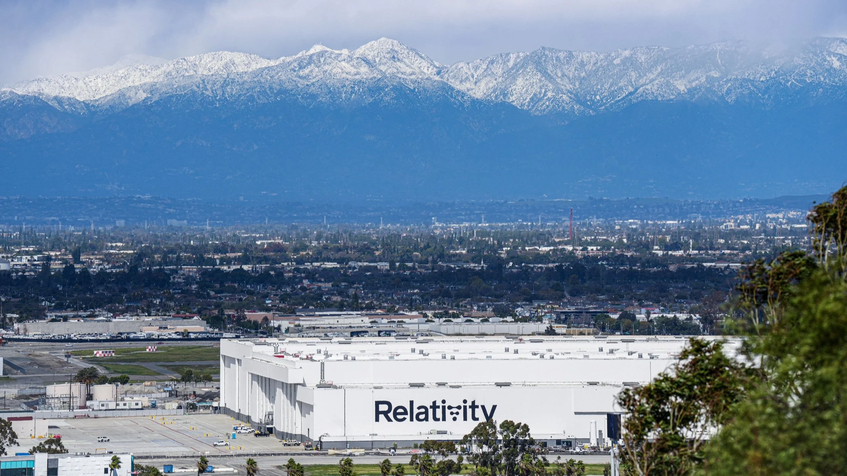
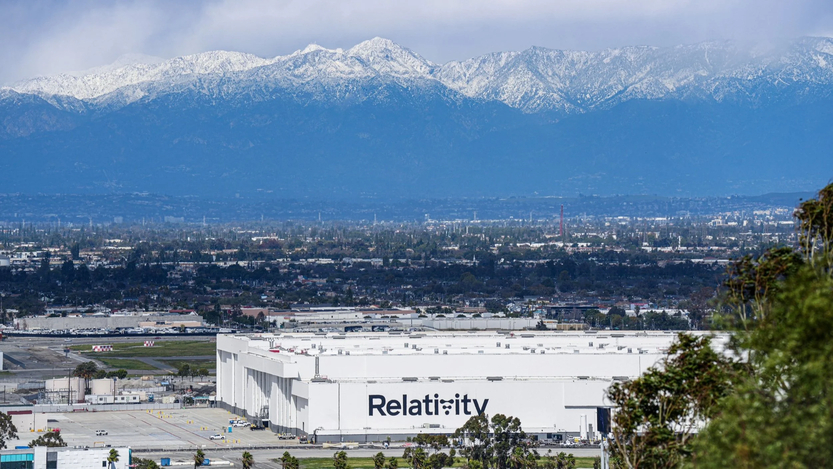
Home to Terran R production, cutting-edge manufacturing, and advanced testing infrastructure, our headquarters in the Los Angeles metro area is shaping the future of aerospace. Designed for scalability, this facility is designed to support high-rate production and can adapt to customer demand.
Similar Jobs at Relativity Space
What you need to know about the Los Angeles Tech Scene
Key Facts About Los Angeles Tech
- Number of Tech Workers: 375,800; 5.5% of overall workforce (2024 CompTIA survey)
- Major Tech Employers: Snap, Netflix, SpaceX, Disney, Google
- Key Industries: Artificial intelligence, adtech, media, software, game development
- Funding Landscape: $11.6 billion in venture capital funding in 2024 (Pitchbook)
- Notable Investors: Strong Ventures, Fifth Wall, Upfront Ventures, Mucker Capital, Kittyhawk Ventures
- Research Centers and Universities: California Institute of Technology, UCLA, University of Southern California, UC Irvine, Pepperdine, California Institute for Immunology and Immunotherapy, Center for Quantum Science and Engineering
