
How BAE Systems Is Redefining Military Training
In 2025, during the annual Maneuver Warfighter Conference — a recurring U.S. Army event that discusses and develops concepts for the future of warfighting — BAE Systems unveiled new technology that has been sought after since the early 1980s.
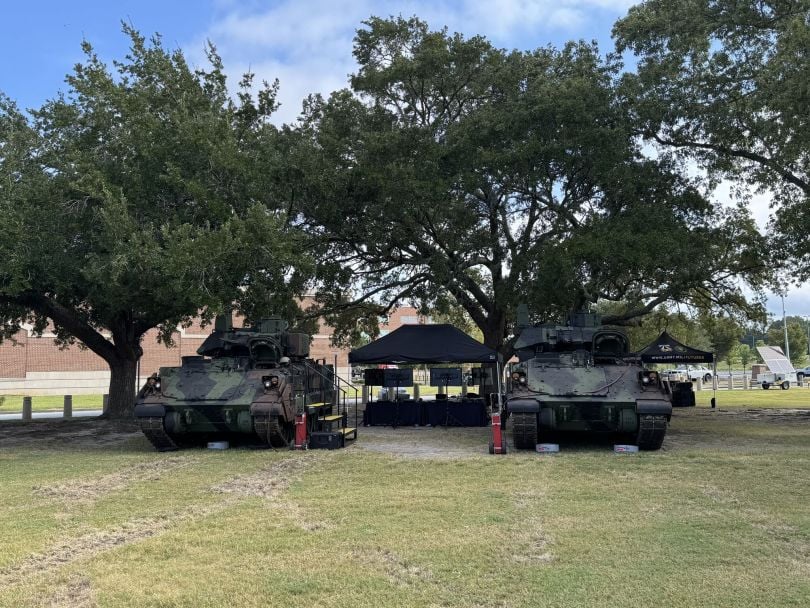
The synthetic training solution, Embedded Collective Training, uses AI and immersive virtual environments to help military personnel prepare for real-world missions. The technology gives warfighters the ability to train collectively in highly realistic and adaptive scenarios across domains, while simultaneously reducing the cost and risk associated with traditional military training.

Zach Chatelain, data manager for BAE Systems’ platform digitization efforts, worked in tandem with other technologists at the company to build the new solution.
“It was a challenging months-long effort that resulted in U.S. Army senior leadership validating our solution,” he said.
Since joining the company in 2016 as an intern to work on automation for geospatial data analysis, Chatelain has discovered an overarching truth about his employer’s line of work: “Change is a constant.”
The company’s new synthetic training technologies reflect this ongoing evolution. In addition to the Embedded Collective Training platform, the company recently launched its Virtual Proving Ground, a digital engineering environment that enables the company to rapidly test and adapt new defense technologies using digital twins.
According to Chatelain, these solutions and others demonstrate the company’s dedication to redefine military training while empowering technologists to pursue meaningful, mission-driven careers.
“Careers in this area blend advanced research, software development and human performance science to support one powerful mission: ‘We Protect Those Who Protect Us,’” he said.
How BAE Systems Built Its Latest Tech
To bring the Embedded Collective Training platform to life, Chatelain worked with BAE Systems’ engineering team dedicated to developing the Bradley Fighting Vehicle, an armored vehicle used by the U.S. Army and its allies.
Alongside the Bradley team, he helped bring VBS4, the company’s advanced whole-earth training and simulation software, into the armored vehicle. In doing so, Chatelain played a key role in providing cutting-edge technology to the U.S. Army at the point of need.
He and his teammates encountered — and overcame — their fair share of challenges while developing the Embedded Collective Training platform. Geographical barriers required frequent technical exchange meetings and a clear North Star to stay aligned on project goals, and some of the team leaders had to focus on other major tasks at the time. Chatelain said the experience led to at least one major lesson throughout the development process.
“Clear communication and planning with the right team can overcome any technical barrier that presents itself,” he said.
“Clear communication and planning with the right team can overcome any technical barrier that presents itself.”
Chatelain’s team is made up of individuals with diverse experience and skill sets, including software engineers, test engineers and former military personnel. This wealth of expertise, coupled with a strong focus on collaboration, was critical to the project’s success.
“Our ability to quickly plan and strategize our development efforts over several sprints with obtainable outcomes really stood out as an effective practice,” Chatelain said. “We could take advantage of our success while correcting issues before they became a roadblock.”
For him, the key to success in this undertaking was the unified desire to deliver an impactful solution for the U.S. military.
“We aligned quickly, stayed focused and supported each other through each phase of development,” Chatelain said. “This kept the outcome first, so that our soldiers are staying safe while enhancing their capabilities on the battlefield.”
The Impact of Working at BAE Systems
“When I first started at BAE Systems, projects I contributed to were pathfinders showing the art of the possible that might be included in future solutions,” Chatelain said. “Now, I look at advanced technologies as something that can help today.”
Throughout the last 10 years of working at BAE Systems, Chatelain has worked with a wide range of customers, all while embracing the quick adoption of evolving technologies. He said that the company’s technologists are encouraged to constantly build up their knowledge base and apply their area of expertise to meet customers’ demands, which is something he experienced firsthand when developing the Embedded Collective Training platform.
“Throughout the year, I have had to learn Army training doctrine, read wiring diagrams, use training software, splice wires, and build cable harnesses,” Chatelain said. “This isn’t to say that’s what everyone will need to do, but learning about customer challenges and how BAE Systems is adapting to meet those challenges opens the door to being the solution.”
Those who join BAE Systems are expected to “be the solution,” and to do so, they must dive into their work — and learn as they go.
“Much of what we do is groundbreaking at the enterprise level,” Chatelain said. “There are so many moving pieces to this puzzle.”
Engineers, data scientists and AI specialists at BAE Systems can expect to work with cutting-edge technology on mission-critical projects with an immediate and lasting impact. And the best part?
“There is always something to learn,” Chatelain said.
Frequently Asked Questions
What is it like to work on AI-powered military technology at BAE Systems?
Technologists work on mission-critical projects that blend advanced research, software development and human performance science. Teams collaborate across disciplines to build and test cutting-edge solutions that directly support military readiness and safety.
What kinds of AI and digital technologies does BAE Systems develop?
BAE Systems develops AI-powered synthetic training platforms like Embedded Collective Training and digital engineering environments such as the Virtual Proving Ground, which uses digital twins to rapidly test and adapt defense technologies.
How do engineering teams collaborate at BAE Systems?
Teams include software engineers, test engineers and former military personnel who plan development work in focused sprints with clear goals. Strong communication, alignment on mission impact and cross-functional collaboration help overcome technical and logistical challenges.
What skills and mindset are important for technologists at BAE Systems?
Employees are expected to continuously learn, adapt to evolving technologies and deeply understand customer challenges. Success requires diving into complex, groundbreaking projects and applying technical expertise to deliver impactful solutions for the U.S. military.